Electronic Numerical Integrator and Computer (known as ENIAC)
was the first electronic digital computer large scale. Many say that the first was the Mark I, but this was just electromechanical. It was created in February 1946 by US scientists John Eckert and John Mauchly, the Electronic Control Company
The ENIAC was first developed in 1943 during World War II to compute tactical trajectories that required substantial knowledge in mathematics, but only became operational after the end of the war.
- Its processing capacity was 5,000 transactions per second;
- Created in the second war, had as its main purpose ballistic calculations;
- Had 17,468 thermionic valves, 160 kW;
The "operating system" of the machine was using punch cards.
The calculator performs calculations from keystrokes, making direct interaction with the hardware, such as the ENIAC, which was necessary to connect wires, relays and key sequences to it to determine the task to be performed. Each different task the process should be redone. The response was given by a sequence of lamps.
Production
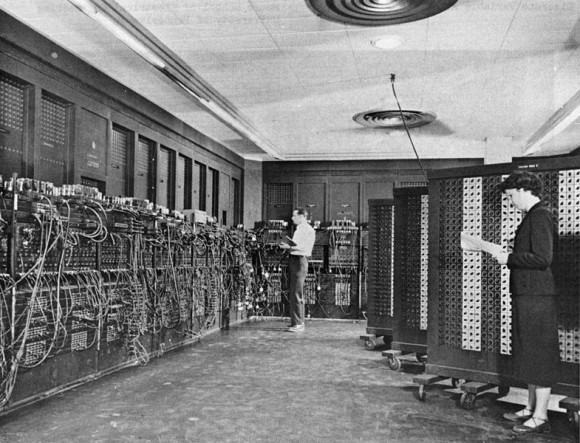
It was so big it had to be arranged in U with three panels on wheels, so that operators could move around it. They were spending about $ 500,000.00 (five hundred thousand) in its construction. In operation, other complex calculations ballistic began to coolest place in 30 seconds, while with manual calculators that used hitherto led to 12 hours to obtain the same result. The processing center had a structure very similar to the most basic processors currently used in our pocket calculators. 20 had records of ten digits each, where they could perform addition, subtraction, multiplication, division and square roots.
The programmers of ENIAC
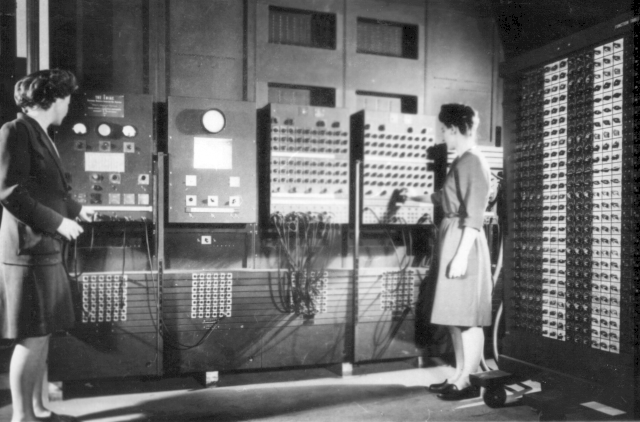
The ENIAC was programmed through thousands of switches, each of them can take the value 1 or 0 depending on whether the switch was on or off. For the program a lot of people who roamed the long lines of switches giving the ENIAC necessary instructions needed to compute, or estimate. There was a team of 80 women at the University of Pennsylvania whose function was to manually calculate the necessary differential equations for calculation of ballistics. The army called the function of these people: computers. When the ENIAC was completed, six women were chosen to test the new machine.
Two women operating the ENIAC (photograph belonging to the US Army (US Army)).
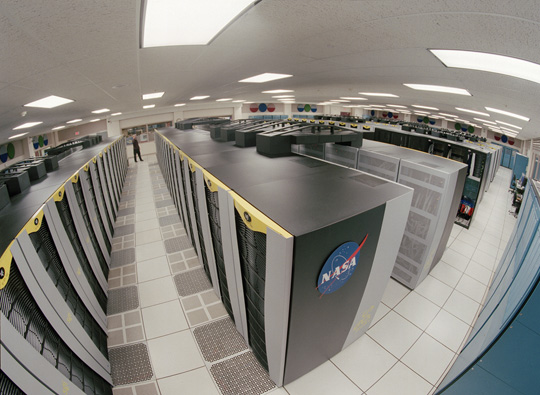
Modernized version of the ENIAC:
Interestingly, the term no longer associated with the persons operating the machine to machine the name itself, since in fact the machine started to carry bills that were previously made by those persons. The ENIAC becomes obsolete and uneconomical to maintain after 10 years of operation, having been dismantled. Today are parts of ENIAC by many museums in the world, including the Smithsonian in Washington DC and at the very place where it was built, the Moore School for Electrical Engineering at the University of Pennsylvania.
Later development:
The ENIAC was the inspiration for many other computers that followed, as the EDVAC (Electronic Discrete Variable Computer); the ORDVAC (Ordnance Variable Automatic Computer); SEAC (Automatic Computer Standards) and oUNIVAC, the latter also constructed by Eckert and Mauchly for processing the data of the American population census. In 1955, a computer weighed 3 tons and consumed 50 kW of power, with a cost of $ 200,000. Such a machine could perform 50 multiplications per second. Thus, the first computers were also machines that they were only available to large companies or institutions that were very demanding calculation needs and who held the economic conditions for such a large investment. With the rapid development of transistors between 1952 and 1960 vacuum tubes became obsolete and was this technological breakthrough that allowed the creation of much faster, smaller and cheaper machines. Over time, the transistors have become the base of electronics, followed by VLSI (Very Large Scale Integration), or the construction of ever smaller circuit so that could be lighter and expend less energy, they have less surface area for the dissipation of heat energy. This miniaturization enabled if it had the same one ENIAC computing power in the palm of a hand. The decrease in size has also decrease the amount of energy required and the cost down with the serial production of new processors.
In 1977 a manual calculator weighed less than half a kilo, consumed half a watt and could perform 250 multiplications per second, costing $ 300. Today a calculator weighs a few grams can be incorporated in rules or schedules, works to solar energy and expense of $ 1.00 to R$ 5.00 (this simple calculators with basic operations and generally square root and a few other functions).